Posture Coaching
Poor posture isn’t given nearly the credit it deserves in the cause of pain syndromes and eventual disease. Similar to autoimmune diseases where body cells attack other body cells causing damage and disease, poor posture coupled with gravitational forces and time can create enough stress that your body is actually damaged by your own body!
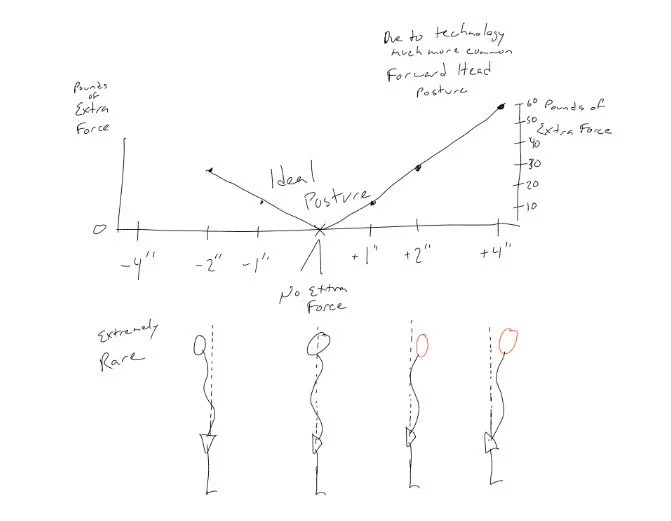
A forward head postural distortion also known as “Tech Neck” is an example of that. Although increasingly common due to technology, forward head posture excessively loads the discs and facet joints in the spine leading to disc herniations, pain disorders, radiating pain, numbness, stenosis, and premature osteoarthritis. Additionally, forward head posture causes increased and sustained stress to the muscular system and tension in the spinal cord leading to tight muscles, aching rock hard and tender trigger points, headaches, restricted range of motion, and increased likelihood of hyper sensitivity disorders and autonomic dysfunction.
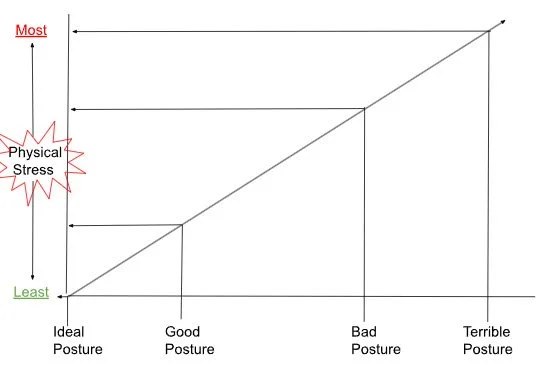
A “bad” posture is one that creates increased force or tension into the tissues of your body when compared to ideal posture. Posture is essentially the math (physics) of the body (matter) plus gravity (energy of attraction) played out in the daily positions of your different body parts. You see, there is a point mathematically in which you can sit or stand that maximally reduces the forces internally on your tissues and that is “ideal posture.” The further from that point, the worse the posture because it induces more and more stress on your body tissues.
Despite the physics involved in posture, for conceptual purposes, this is pretty simple. Think about holding a bag of groceries (or a child or a bowling ball). Is it physically harder to hold those groceries closer to your body or further from your body? If you were to hold them out in front of your body as far as you could, would it be easier or harder to hold them for 5 minutes? The variables that influence posture are time, weight of body part and distance from center.
Now we can apply this concept to your posture by understanding that your different body parts actually act as that object load like the bag of groceries. What I mean is that if you were to lay just your head on a scale you would find that it weighs approximately 10-15 pounds. That weight has to be dealt with by your lower neck, mid back and even lower back. That’s ok because they were built to deal with that weight. However, the position your head or torso is in drastically affects the amount of force that it places on the lower sections of your body. The further from ideal posture, the more force and pressure your lower sections have to deal with and they just weren’t designed for text neck positions all day. Posture is a gray scale on each side of an ideal point where good alignment is the position with the least amount of force. The further your posture goes from that point in any direction the worse the posture and the greater the forces (aka stress).
The position of your body at which the least amount of force is created inside your body is called ideal posture.
There are many factors that come into play regarding posture correction and coaching is one of the most important. In our clinic, we tackle this topic in three ways:
By providing education similar to what you’re reading here coupled with
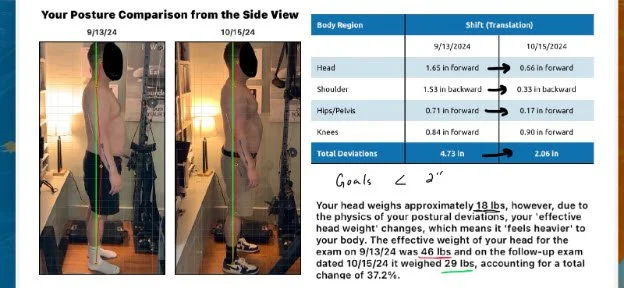
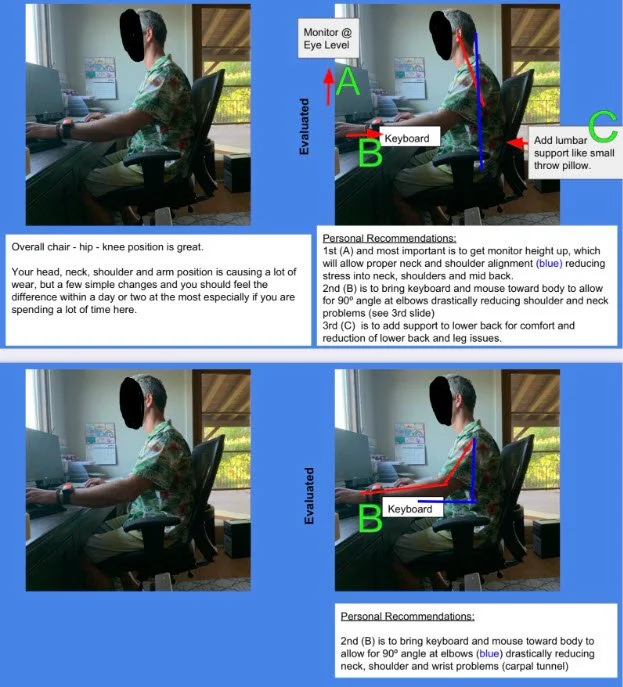
Visual understanding using
a. examination pictures (top of this article) and
b. workstation ergonomic evaluation pictures (right), and
3. Kinesthetic learning via bio feedback taping as well as physical hands-on demonstrations to help clients feel their ideal posture.
Each patient learns best through different means and so when you use all three methods of learning, idealized posture clicks for the patient, there is typically an ah-ha moment and they can feel the reduction in stress with better posture. We then provide accountability and repeated check-ins to course correct, answer questions and ensure success.
When posture coaching is coupled with spinal remodeling traction, specific chiropractic adjustments, specific therapeutic exercises and time, we are consistently able to break through plateaus in healing and rehabilitate bodies and reduce symptoms often thought impossible.